Explain the effect on family life
Record examples from routines, learning, friendships and home life, alongside the background that helps someone understand your child.
Bring your observations, your child's history and available school input together. Start with free screening, then choose whether a clinician-reviewed ADHD Passport would help you take the next step with school or your GP.
Free screening · Optional £99 clinician-reviewed Passport · No subscription
Record examples from routines, learning, friendships and home life, alongside the background that helps someone understand your child.
Invite a teacher or education setting to contribute. Their perspective appears separately, so important differences are not lost.
Take your Passport to a GP or SENCo meeting to discuss support needs and whether further formal ADHD assessment is warranted.
No card is required. Your mobile number is optional and is used for screening updates and reminders if you choose SMS.
Complete the parent sections about your child and invite the school if appropriate. Save and return when it suits you. You can speak supported written answers and review the transcription before saving.
Review your answers and outstanding contributions. You can wait for an informant before choosing the £99 Passport. Completing the screening does not commit you to buying.
If you purchase, a NeuroFX clinician reviews the information before release. Your Passport is normally ready within five working days of payment, with an expected date shown in your account.
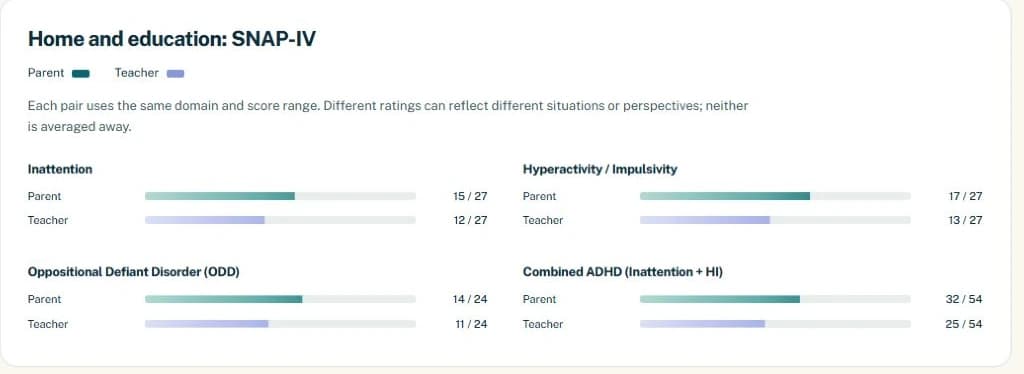
From our complete fictional child sample. Open the full Passport and PDF
The example is fictional. Your own Passport is prepared after purchase, using the information you provide.
Teacher observations can add important context about how your child manages in a different setting. You remain in control of invitations.
If a contribution is missing, we make that clear and give you the opportunity to wait. You are notified when a contribution arrives. A Passport can be prepared without it, but the limits of the available evidence will be recorded.
Your £99 Passport combines an introduction letter, clinician-reviewed summary, questionnaire findings, visual summaries, relevant history and available informant evidence. It is one downloadable PDF, digitally certified by Neuro FX Ltd after approval.
See everything the Passport includesIt can help explain needs and inform support conversations. It is a screening and pre-assessment document, not a diagnosis. A qualified clinician must make any diagnostic or treatment decision through a comprehensive assessment.
Using it with your child's schoolComplete your screening at your own pace. You can decide whether to buy your £99 Passport when you finish.